
New World
"New World" is a massively multiplayer online role-playing game (MMORPG) developed and published by Amazon Games, first released in September 2021 for PC. It’s set on the supernatural island of Aeternum, inspired by the Age of Exploration and filled with both natural beauty and dark magic.
Exploring a massive, beautiful world filled with danger requires an enormous amount of content; guns, swords, sorcery, nature, ruins, and fearsome enemies.
I began my work on New World as an Outsourcing Producer, then progressively expanded my scope to oversee VFX Production and AI & Creatures.
OUTSOURCING

As Outsourcing Producer, I led a team of 6 internal artists and coordinated with about 16 global studios to develop art assets needed for New World's initial launch and a steady pipeline of content for live updates and store content to sustain us financially.
My team's goal, as always, was consistently high quality at a low cost.
I maintained an 8-figure external development budget that reliably came in under budget, allowing us to expand the team's services to better serve the studio and the game.


My team's launch goals included over 500 assets ranging from armor and weapons rewards to foliage and architecture for various zones in the world, UI art, emotes, and more...
We also maintained most of the in-game store offerings that kept New World funded. Because our store goal was to provide strictly cosmetic items with no pay-to-win elements, maintaining high visual quality was essential.
With the store offerings cycling monthly, we needed to crank out content reliably fast.
I built external development capacity tracking to facilitate a reliable schedule with achievable team goals, onboarded new vendors, and negotiated deliverables to meet tough deadlines.
The delivery timeline for these huge demands was under 6 months, with some internal teams needing their assets sooner for implementation. This required speed, strategy, and careful planning. When I joined the team, there was no structure for estimating capacity and the team was feeling overwhelmed with how much content had to be reviewed for technical specs, quality, and to check against potential plagiarism. A lot of work was getting delayed, hurting relationships with our vendors and causing content to fall behind.
I built an entirely new scheduling structure for our outsource pipeline, including bidding, development, and review cycles which gave a clear quantifiable measurement for how much the team could review in a period and how risk was involved. We went from around 60% of assets delivering on time to about 97% on time.


Once that measurement structure was in place, that data revealed how much we needed to adjust our schedule. We weren't going to be able to deliver all of our launch assets as committed before I joined the team. I brought the newly organized data to stakeholders with a combination of solutions:
- Replace some original assets with kitbashes to extend our content.
- Move some lower priority assets out of the launch delivery and communicate that prioritization to our vendors.
- Add more vendors to fill in gaps.
- On lower priority assets, focus on technical specs and critical quality, letting some assets pass approval with a lower quality bar where acceptable.
The new process and commitments allowed us to find a satisfying balance for stakeholders while keeping an achievable target for the team.


This process continued, supporting the store as well as content updates, including all major holiday events.
To continue cutting development costs and free up capacity for our internal team, I coordinated expanding to prop concepts, tasking one our artists with documenting the metrics for tents, being an item we'd need consistently, it made for a reliable starting point. Determined an existing vendor also interested in expanding to concept, and it worked well. Cut costs by about 50% and let our artists focus on more critical work.


VFX PRODUCTION

I took on VFX Production on top of outsourcing following the previous producer's departure. Our two senior VFX artists accepted jobs elsewhere, leaving us with one artist to support the whole game. This included VFX for new weapons, ambient environment effects, new creatures, and much more.
My challenge as a producer was to maintain VFX support with this very tight capacity while growing the team. The previous process for estimation and scheduling had been fairly relaxed with our senior artists and needed to be more precise. Before the team shrank, I guided the creation of an estimate guide to set expectations for other team's requests, setting cost estimates for AoE, projectiles, explosions, etc. These gave stakeholders a clearer breakdown of cost so we could more easily communicate and adjust scope.
I also discussed low priority VFX asks with our stakeholders that could be either cut or reuse existing VFX, reserving support time in the schedule for our remaining artist to advise on VFX hookup. I switched us from two-week sprints to one-week sprints to be more agile for emergent support needs. All this kept us able to deliver the most critical VFX elements in very dire circumstances. Eventually, I was able contract temporary VFX support from an external vendor as we grew the team back to full size.

The Nightveil Hallow event for Halloween was one of our first big deliverables since I took on VFX Production. This included a spooky cauldron in the settlements and the shadowy demon Baalphazu, Marquis of Terror.
The VFX challenge of Baalphazu's controlled chaos was fast and hectic combat in a large boss space with an epic atmosphere. This required excellent visual presentation, while being optimized for around 200 players in the open world. On the production side, this meant tracking progress carefully, communicating progress to stakeholders, and shuffling assignments when art needed more optimization to be performant.
The best moment of the Baalphazu fight (aside from everything), is his final death explosion, completely nailing the goal of an 80’s cult horror villain death. It is a perfect celebratory moment to close out the encounter.

In one case, the new estimation process revealed a major upcoming boss was over-scoped for VFX.
The final boss of the Empyrean Forge expedition was originally designed with VFX costing 50+ days, compared to around 35 days for most bosses previously. Our team was still fairly small at the time, so we needed to adjust expectation with stakeholders. That estimate guide I made earlier with the team made the conversation clear and smooth. Some lower priority abilities were simply cut. The lava pool effect was particularly technically demanding, but essential to the fight. In that case, we met with Tech Art and Engine to find a more simple solution that fit our schedule.
Commander Marius retains his chaotic energy, forcing players to contend with a lava filled floor or pancaking lava boulders that fall from the ceiling. Players have to avoid mini volcanoes, Commander Marius spinning around the room, falling boulders, and rising lava.
AI & CREATURES PRODUCTION

Immortality comes at a cost. Aeternum is infested with lethal enemies ranging from the Ancients to the Angry Earth.
I led a team of 11 Designers and Engineers internally plus 3 more teams of co-developers, including managing those other teams' producers. This allowed us to develop dozens of creatures at a time for quarterly content drops while maintaining the live game.

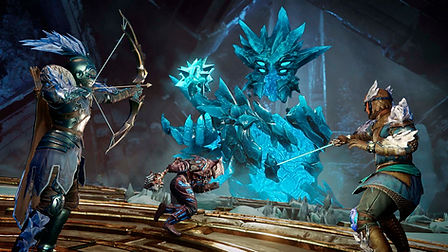
The dozens of creatures we developed included everything from critters found in the open world to dungeon bosses and raids.
When I first joined, our tracker was extremely manual, using Jira .csv exports in combination with excel to assemble a report -- but one easily disrupted by non-conforming naming conventions and not flexible to differences between creatures and their individual complexities. This constantly cost extra hours of my busy schedule to maintain and wasn't always accurate or updated.
To improve this process, I scrapped the excel format and made a new automated tracker. This started with making a jira template for creature development, capturing the full pipeline of everything needed for each creature. This ensured everything was accounted for in planning, maintained consistent ticket names, and saved time for not just me but all the other content producers with whom we collaborated. Witht that template in hand, I pulled everything together into a jira structure that served as the new tracker; always updated with the latest statuses and easily accessible to stakeholders without needing to be manually maintained. This saved around 20% of time spent each week.
Expanding on that automated tracking, there was more process to be optimized.
Our creature pipeline followed a thorough approvals process across Art, Animation, Design, and QA to ensure quality. This approval process was also manually tracked in a spreadsheet, with a report on review feedback turnaround times compiled manually each week. To improve this, I incorporated that approval process into the jira template format for each creature and followed up with a dashboard that compiled all the info on turnaround times, so the report was always automatically available with the latest info. That dashboard also served as a reliable way for those approvers to check which features needed their urgent attention. This saved production about 4 hours each month while providing more comprehensive info.

Sometimes, I had to advocate for more investment on a feature I believed in.
This work on creatures included updating story bosses in the entire New World main story questline from end to end. Improvements were made across the board to the story campaign, including fresh narratives, more variety, and a few new surprises as players make their way through an epic story and its nail-biting conclusion.
We took the best elements we already had, including reworking the big bad herself, Isabella. When the request for her rework was made, the desired deadline was extremely close. Doing even the bare minimum would be extremely risky, and it simply had to be a climactic conclusion. Together with the designer, I showed how the timeline stakeholders wanted wouldn't deliver a quality experience and we agreed to move this to a later release to make it awesome.
Many players now regard the main story's climactic conclusion as one of its most memorable fights.